How Strict is Pasadena on First-Time DUIs?
Pasadena first-time DUI penalties include standard California fines and jail time, but local court practices often involve strict oversight from the Los Angeles County District Attorney or Pasadena City Prosecutor.
While state law sets the baseline, judges at the Pasadena Courthouse may require specific terms like mandatory ignition interlock devices or intensive alcohol education programs even for a first offense.
A first offense in this jurisdiction generally leads to a combination of fines, driver’s license restrictions, and mandatory education programs. Pasadena’s first-time DUI penalties align with California state law, but the local court system often applies them with close scrutiny.
Contacting a criminal defense attorney who understands the local landscape is a common step for those looking to manage these requirements effectively.
The uncertainty following a traffic stop near the Rose Bowl or along Colorado Boulevard can be deep and stressful. It is natural to worry about how a mistake might impact your ability to drive to work or maintain your reputation in the community.
The legal system is complex, and the specific ways a local prosecutor handles your case can change your future significantly.
What You Need to Know
- Baseline Fines: Financial penalties often start with base fines of $390 but may exceed $1,800 once court assessments and state fees are added.
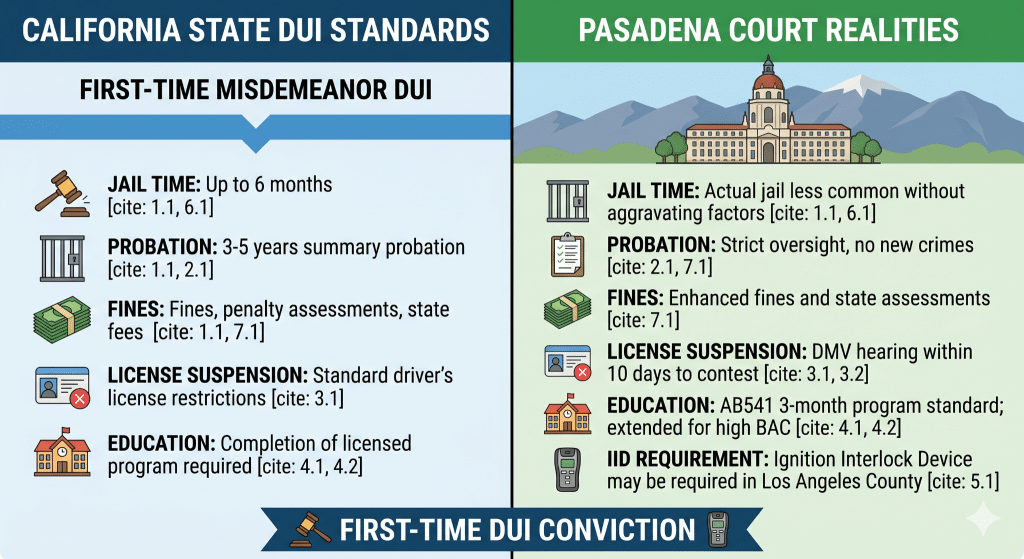
- License Suspension: The DMV typically initiates an administrative suspension that requires a separate hearing to contest within 10 days of the arrest.
- Mandatory Education: Most first-time offenders must complete a licensed three-month alcohol and drug education program known as AB541.
- Ignition Interlock Requirements: Los Angeles County often requires the installation of a device that measures breath alcohol before a vehicle will start.
Comparing State Standards and Pasadena Court Realities

California law provides a range of punishments for driving under the influence, but the actual sentence often depends on the policies of the local prosecutor’s office. In Pasadena, cases are handled by either the Los Angeles County District Attorney or the Pasadena City Prosecutor.
While the state allows for a maximum of six months in jail for a first-time misdemeanor DUI, actual jail time is less common for first offenders unless there are aggravating factors. However, the Pasadena Courthouse is known for being thorough, and judges may look closely at your blood alcohol concentration levels when deciding on probation terms.
Defining Informal Summary Probation
Summary probation is a type of legal supervision where the court monitors your behavior without requiring you to meet with a probation officer. Instead of regular check-ins, the primary requirement is that you do not commit any new crimes and follow all court orders, such as paying fines or attending classes.
For example, if the court grants three years of summary probation, you may continue your daily life, but any subsequent traffic violation or arrest could trigger a probation violation. In such a scenario, the judge might reinstate the suspended jail time, turning a manageable situation into a serious setback.
Financial Obligations Beyond the Initial Fine
Court fines are only the beginning of the financial impact of a DUI conviction in California. The base fine is usually around $390, but penalty assessments, which are state-mandated multipliers, can increase that total by several hundred percent.
Consider a situation where a driver is ordered to pay a $400 fine. After adding laboratory fees, night court assessments, and state restitution funds, the actual bill at the clerk’s office could be closer to $2,000. Our firm works to ensure you understand the full scope of these costs so there are no surprises during the resolution of your case.
The Role of Aggravating Factors in Local Sentencing
Not all first-time offenses are treated the same by the court. Certain circumstances, known as aggravating factors, may lead the prosecution to seek harsher Pasadena first-time DUI penalties. These factors suggest a higher risk to public safety and often result in more intensive probation requirements.
High Blood Alcohol Concentration (BAC) Enhancements
Under California law, a BAC of 0.15% or higher is considered an aggravating factor that can lead to enhanced sentencing. While the standard first-offense program is three months, a high BAC may cause the judge to order a six-month or even a nine-month alcohol education program.
Imagine a driver who tests at 0.16% BAC. Even though it is a first offense, the prosecutor might argue for the AB1353 program, which lasts nine months and involves more hours of counseling. This increased commitment impacts your work schedule and increases the total cost of the program fees.
The Impact of Refusing a Chemical Test
Refusing to provide a breath or blood sample after a lawful arrest is a separate violation that carries its own set of strict penalties. In California, the “implied consent” law means that by driving, you have already agreed to testing if arrested for DUI.
For example, if a driver refuses a breath test in Pasadena, the DMV may issue an automatic one-year license suspension with no option for a restricted license. Our team reviews the body-cam footage of the refusal admonition to see if the officer correctly explained these consequences, as a failure to do so could be a defense.
Navigating the Process of Evidence Review
Gathering and analyzing evidence is the foundation of any strong DUI defense. This process involves more than just reading a police report; it requires a deep dive into the technical and procedural details of the arrest.
Scrutinizing the Initial Traffic Stop
The Fourth Amendment protects you from unreasonable searches and seizures, meaning an officer must have reasonable suspicion to pull you over. If the police did not have a valid legal reason for the stop, the evidence they gathered afterward might be suppressed.
Suppose an officer stops a vehicle because they thought the driver looked tired, but no traffic laws were broken. Our firm would file a motion to suppress, arguing that the stop was unlawful. If the judge agrees, the entire case could be dismissed because the evidence from that stop cannot be used in court.
Analyzing Chemical Test Accuracy
Breath and blood tests are technical procedures that must follow strict guidelines under California’s Title 17 regulations. Any deviation from these rules can call the accuracy of your results into question.
For instance, we request the maintenance logs for the specific breathalyzer used during your arrest. If the records show the machine was not calibrated within the required timeframe, we use that information to negotiate with the prosecutor for a reduction in charges.
Mandatory Education Programs and Their Requirements
If convicted of a DUI in Pasadena, the court will almost certainly require enrollment in a licensed DUI program as a condition of probation. These programs are designed to provide education on the risks of impaired driving and to identify potential substance abuse issues.
The AB541 Three-Month Program
The AB541 is the most common program for first-time offenders with a BAC below 0.15%. It consists of roughly 30 hours of instruction, including lectures, group sessions, and individual interviews.
In a typical scenario, a participant would attend one class per week for 12 weeks. In Los Angeles County, this program also usually requires attending six additional self-help meetings, such as Alcoholics Anonymous (AA). Our firm assists you in finding an approved provider near your home or work to make compliance as easy as possible.
Advanced Programs for High BAC Cases
For cases involving higher alcohol levels, the court may mandate the AB762 (six-month) or AB1353 (nine-month) programs. These require significantly more time and financial investment than the standard three-month class.
For example, the nine-month program involves 10 classes, 30 group sessions, and 19 self-help meetings. Proving the necessity of a shorter program is a key part of our negotiation strategy when mitigating factors are present in your case.
The Two-Track System: Court vs. DMV
It is important to understand that a DUI arrest triggers two separate legal battles: one with the criminal court and one with the DMV. Winning in one does not automatically mean you win in the other.
The 10-Day DMV Hearing Rule
When you are arrested, the officer likely took your physical license and gave you a pink piece of paper. This is your temporary license, but it only lasts for 30 days. You have exactly 10 days from the arrest to contact the DMV and request a hearing to stop the automatic suspension of your driving privileges. Understanding your rights during a DUI stop can help you make informed decisions and protect your ability to challenge the suspension.
If we request the hearing for you, the DMV will “stay” the suspension, allowing you to keep driving until the hearing takes place. This provides valuable time to organize your affairs and potentially resolve the court case first.
Administrative License Suspensions
The DMV hearing focuses on three main questions: did the officer have reasonable cause, was the arrest lawful, and was your BAC at or above 0.08%? This is an administrative process, not a criminal one, so the standard of proof is lower than beyond a reasonable doubt.
For example, even if the prosecutor decides not to file criminal charges, the DMV can still suspend your license if they believe the 0.08% BAC was accurately measured. We represent you at these hearings to challenge the evidence and help you maintain your ability to drive.
Long-Term Consequences and the Path to Expungement
A DUI conviction can affect your life long after you have finished your classes and paid your fines. However, California law provides a path to clear your record once you have successfully completed all terms of your probation.
What About the Effect on Your Record?
A DUI remains on your driving record for 10 years, which can lead to significantly higher insurance premiums. On your criminal record, it will appear as a misdemeanor conviction, which you may be required to disclose on some job or housing applications.
For example, a professional with a commercial driver’s license (CDL) might face a one-year disqualification of their commercial privileges for a first-time offense in their personal vehicle. We work to minimize these collateral damages by seeking reductions to non-alcohol-related charges whenever possible.
The Expungement Process (Penal Code 1203.4)
Once you finish your probation, you may petition the court to have your conviction expunged. If granted, the court will withdraw your guilty plea and dismiss the case, allowing you to legally state that you were not convicted of that crime for most private employment purposes.
Suppose you were sentenced to three years of probation in 2023. In 2026, after completing all your classes and paying every fine, our firm could file a motion to dismiss the case under PC 1203.4. This process helps you move past the mistake and protects your future career opportunities.
FAQ for Pasadena First-Time DUI Penalties
Will I have to go to jail for a first DUI in Pasadena?
While jail is a legal possibility, many first-time offenders are sentenced to probation, fines, and alcohol school instead of time behind bars, provided there were no injuries or high-speed chases.
Can a DUI charge be reduced to a Wet Reckless in Pasadena?
A wet reckless is a frequent plea bargain for first-time offenders where the evidence of impairment is borderline or there are other mitigating factors in the case.
What is the AB541 program required by the court?
The AB541 is a state-licensed three-month alcohol education program that includes group counseling and educational classes, which is a standard requirement for most first-time DUI convictions.
Do I need to install an ignition interlock device (IID)?
Los Angeles County often makes IIDs mandatory for first-time offenders who wish to keep driving without restrictions during their suspension period.
What happens if I missed the 10-day DMV deadline?
If the deadline is missed, your license will automatically be suspended after 30 days. However, you may still be able to apply for a restricted license later in the process.
Moving Toward a Resolution
Grasping the full scope of Pasadena first-time DUI penalties is the most effective way to start regaining control over your situation. While the penalties are strict, the legal system provides specific pathways for those willing to address the requirements and defend their rights. A Pasadena DUI lawyer can help you understand your options and build a strong defense strategy.
Every case contains unique details that can change the final outcome, from the reason for the stop to the way evidence was handled by the lab.
What would it mean for your future to have a dedicated legal team handling the complexities of the Pasadena court system on your behalf?
Contact the Olen Firm at 213-999-8380 to discuss the specific details of your case and learn how we can help you navigate the road ahead.

"*" indicates required fields